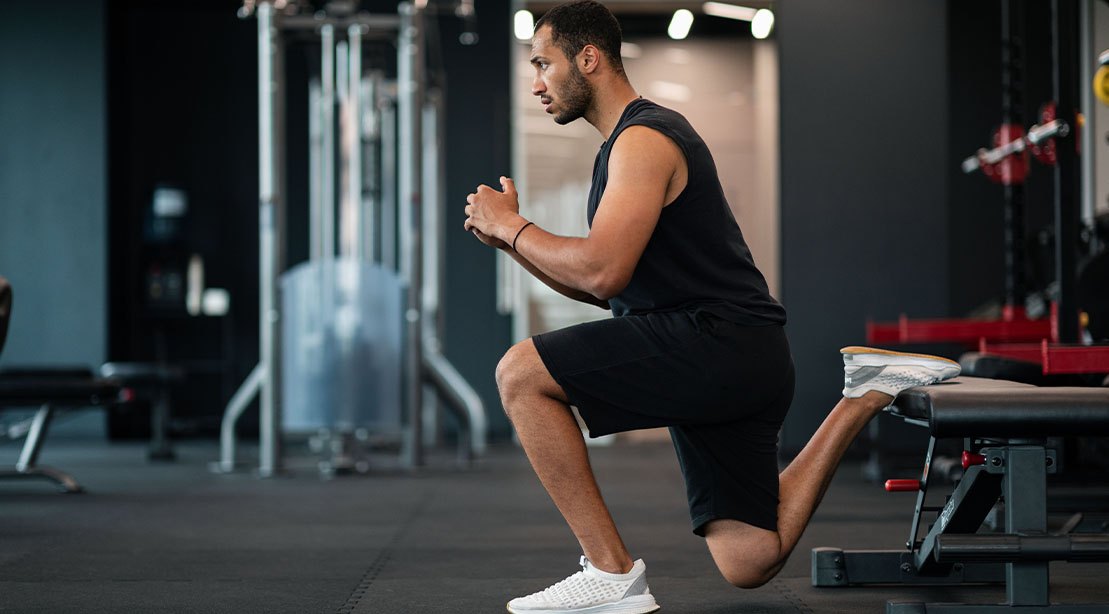
The Bulgarian split squat is the exercise almost all lifters love to hate. Still, you cannot deny its benefits, including increased quad and glute strength and size and reduced strength imbalances, which can improve bilateral squats.
But it has a funny way of humbling those who perform it because it demands more than strength. It requires hip mobility, ankle dorsiflexion, pelvic control, and single-leg stability.
If one of those is off, let’s hope you’re not on camera.
Here, I’ll cover common BSS performance issues and five mobility exercises to help you get the most out of the most dreaded exercise in gym history.
CAN YOU OWN THE BOTTOM POSITION?
Before blaming the Bulgarian split squat for all your woes, let’s test whether it’s a mobility issue.
- Place your rear foot on a weight bench and adjust your stance for balance and comfort.
- Keep your front foot planted, brace your core, and lower into the bottom position.
- Descend as far as you can and hold it for five seconds.
- Drive through your front foot to return to standing, then repeat on the opposite side.
What to Look For
- Differences between sides: Whether one side is deeper or easier to push out of the bottom position.
- Front heel lifting: You may lack ankle dorsiflexion or need to adjust your stance.
- Excessive lower-back arching: Limited rear-leg hip extension or poor hip stability may arch the lower back.
- Front knee collapsing inward: You may lack hip stability.
- Excessive tightness in the rear thigh: Tight hip flexors may be limiting your descent.
- Balance issues: Balance, hip stability, or a poor setup may be to blame.
The goal isn’t a perfect-looking rep but finding any performance limitations that are holding back your gains. But before adding mobility drills, let’s see if it’s a setup issue.
COMMON BSS MISTAKES & FIXES
Not every Bulgarian split squat problem requires another corrective drill. Before blaming tight hips and reaching for the foam roller, a few small adjustments could make a big difference.
WHAT’S NEEDED FOR A GOOD SET
About to perform Bulgarian split squats? Here’s what your body needs to bring to that first set.
A well-performed Bulgarian split squat requires hip and ankle mobility and stability everywhere else. Mobility gets you into position, but strength and stability let you own it.
5 MOBILITY MOVES TO OWN THE BOTTOM POSITION OF YOUR BULGARIAN SPLIT SQUAT
If the adjustments above cleaned up your performance issues, great, you’re good to go. If not, the five mobility exercises below are exactly what you need.
1. Lateral Lunge to Box
The Bulgarian split squat may be an up-and-down exercise, but your hips must also control side-to-side movement to keep your pelvis and knees stable. That’s where the Lateral Lunge to Box earns its keep. It improves adductor mobility and builds hip strength and control, allowing you to reach the bottom without issues.
Why Lifters Need It: The lateral lunge to box trains the adductors through a lengthened position while developing the hip strength and mobility needed to resist excessive lateral shifting.
How to Do It
- Stand sideways, a step length away from a low box or stacked weight plates, with a slight bend in your knees.
- Step onto the box and hinge back into the working hip while keeping your chest up and the opposite leg straight.
- Sink into your working hip as much as you can, then pause for a second.
- Push through the working foot and return to the starting position.
Programming Suggestions: You can perform this unloaded as a warm-up for 10 reps per side, or load it up as an accessory movement for your squats and deadlifts for 2-4 sets of 8-15 reps per side.
https://www.youtube.com/shorts/TML8Vqy-ACQ
2. Couch Stretch
If your rear hip flexors and quads are tight, it’s hard to get to the bottom without arching your lower back. The Couch Stretch targets the hip flexors and quads that can restrict the rear leg.
Why Lifters Need It: The rectus femoris is unique among the quadriceps because it crosses both the hip and knee joints. If it’s restricted, you may feel excessive pulling in the front of your thigh, arch your lower back, or shorten your range of motion to avoid discomfort. The Couch Stretch can restore length to the rectus femoris and the quads.
How to Do It
- Place a folded mat or pad near a wall and kneel with your back to the wall.
- Place the knee on the pad and foot on the wall. Start with your knee farther from the wall if you’re tight.
- Bring your opposite foot forward into a half-kneeling position.
- Squeeze the glute of your kneeling leg, and get tall and brace your abs.
- Slowly bring your torso more upright until you feel a stretch.
- Hold for the desired time, then switch sides.
Programming Suggestions: Perform two sets of 30-60 seconds per side as part of your warmup.
3. Weighted Ankle Rocker
If you struggle to get your knees over your toes, your heel may lift, your balance may suffer, and your knee may have difficulty moving forward. The Weighted Ankle Rocker helps you build that missing range without any mobility circus tricks.
Why Lifters Need It: During the Bulgarian split squat, your front ankle moves into dorsiflexion as your knee travels forward over it. Sufficient dorsiflexion lets you distribute pressure evenly across your foot as you lower to the bottom position.
How to Do It
- Get into a half-kneeling position with your knee underneath your ankle and your knee underneath your hip.
- Hold a light kettlebell or dumbbell on top of your front thigh, just above your knee.
- Keeping your foot planted, slowly drive your knee forward over your toes.=
- Use the weight to help as you move toward your end range.
- Pause, then rock back to the starting position.
- Repeat for reps before switching sides.
Programming Suggestions: Perform two sets of 8 reps per side as part of your warm-up.
4. Front-Foot Elevated Split Squat With Pause
The front-foot-elevated split squat made the list because it promotes deeper hip and knee flexion. You might be able to get into a deep split squat, but if you bounce out of the bottom or lack the strength to hold it, this variation builds the mobility and strength needed for the BSS bottom position.
Why Lifters Need It: If you lack strength at the end of the range of motion, you may rush the eccentric or rely too much on the rear leg. Elevating the front foot lets you practice a deeper split squat position, while adding a pause builds strength there.
How to Do It
- Place your front foot on a sturdy, low platform about 2–4 inches high, and find a comfortable split stance.
- Brace your abs and lower, allowing your front knee to travel over your toes.
- Descend as far as you can while maintaining control of your front foot and hips.
- Pause at the bottom for two to three seconds without relaxing.
- Push through your front foot to return to the start, then repeat for desired reps before switching sides.
Programming Suggestions: Perform two sets of 6 reps per side with a three-second pause at the bottom as part of your warmup.
5. Half-Kneeling Hip Flexor Mobilization With Overhead Reach
There are other hip flexors besides the rectus femoris needed for the Bulgarian split squat. Your iliopsoas, the other hip flexor, also affects how your rear hip extends. This mobility drill strengthens hip extension while maintaining pelvic stability and improves iliopsoas length. The overhead reach and side bend add extra range and intensity.
Why Lifters Need It: When your trailing hip lacks full extension due to short hip flexors, you may compensate by arching your lower back or tipping your pelvis forward as you descend. A few sets of these will have your hips primed for the BSS, even if you are not.
How to Do It
- Get into a half-kneeling position with one knee on a pad.
- Squeeze the knee down glute while keeping your ribs stacked over your hips.
- Reach the same-side arm overhead and bend your torso away from your kneeling leg, without twisting or arching your lower back.
- Hold briefly, return to the starting position, and repeat for desired reps before switching sides.
Programming Suggestions: Perform two sets of 8 reaches per side, pausing for three seconds in the stretched position.
THE FINAL SET
The Bulgarian split squat is tough enough without performance issues fighting you on every rep. The gains happen when you reach the bottom, when the muscles are under a loaded stretch. If getting there is a problem, fixing the setup and mobility issues will help.
Mobility gets you to the bottom, and strength and stability get you out. Master both, and this dreaded exercise becomes one of your best tools for building stronger legs.